Blockchain is transforming cross-border payments by making them faster, cheaper, and more transparent. Traditional systems are plagued by delays, high fees (3%-8%), and inefficiencies caused by intermediaries. Blockchain eliminates these issues using distributed ledger technology (DLT), smart contracts, and stablecoins. This allows payments to settle in seconds or minutes, with fees often below 1%.
Key Highlights:
- Speed: Payments settle almost instantly, unlike the 3–5 business days required by older systems.
- Cost: Blockchain reduces fees to a fraction of a percent by removing intermediaries.
- Transparency: Transactions are recorded on a shared ledger, offering real-time updates.
Stablecoins, pegged to fiat currencies, ensure price stability, making them ideal for global payments. Tools like smart contracts automate processes, ensuring payments are secure and error-free.
Despite its advantages, blockchain faces challenges like regulatory hurdles and interoperability issues. Companies are using compliance tools to navigate these complexities while enjoying the benefits of this payment revolution.
Blockchain Technology for Cross Border Payments – Insight from Matheus Amancio | Brazil 2024
sbb-itb-6893d99
How Blockchain Powers Cross-Border Payments
Blockchain technology is reshaping how cross-border payments are handled. By combining distributed ledger technology (DLT), smart contracts, and stablecoins, it creates a system that is faster, more cost-effective, and transparent for international transactions.
Distributed Ledger Technology (DLT)
DLT serves as the foundation of blockchain-based payments. It operates through synchronized nodes, ensuring that all participants access the same transaction records. This synchronization minimizes delays and enhances fraud prevention. Once a transaction is recorded, it is securely hashed and linked to previous records, forming an unchangeable chain that simplifies auditing and strengthens security. Unlike traditional banking systems limited by business hours, DLT networks function continuously – 24/7/365.
For example:
- JPMorgan Chase‘s Kinexys Digital Payments platform handles over $2 billion in daily transactions, offering near real-time transfers with only a short maintenance window on Saturdays.
- Santander‘s One Pay FX service, built on Ripple‘s blockchain, reduced settlement times for corporate clients from three days to just two seconds.
These advancements in DLT are complemented by the automation capabilities of smart contracts.
Smart Contracts and Automation
Smart contracts are self-executing programs that automatically process payments when specific conditions are met. By embedding rules directly into the blockchain, they eliminate the need for manual oversight or intermediary banks. For instance, a smart contract might release payment only after confirming the delivery of goods or verifying a digital bill of lading.
This technology also enables atomic settlement, where transactions are either fully completed or fail entirely, avoiding stranded funds. A practical example is Walmart‘s blockchain-based supplier payment system, which automatically releases funds once goods are verified on the ledger. This system has significantly reduced payment disputes and cut accounts payable processing costs by 60%.
While smart contracts streamline processes, stablecoins bring an added layer of economic reliability to blockchain payments.
Stablecoins in Payment Systems
Stablecoins address the volatility of cryptocurrencies by pegging their value to stable fiat currencies like the U.S. Dollar (USDC, USDT) or Euro (EURC). These coins are backed by high-quality liquid assets, such as cash equivalents or short-term U.S. Treasuries, held by regulated custodians. This combination of blockchain efficiency and price stability has made stablecoins an attractive option for cross-border transactions.
Currently, the stablecoin market has a capitalization of around $230 billion, with daily trading volumes exceeding $60 billion. Remittance fees using stablecoins are typically less than 1%, a significant improvement compared to the global average of 6.49% for traditional services.
An example of their growing adoption comes from the payroll platform Deel, which reported that freelancers in over 100 countries chose to receive wages in stablecoins by 2025. This option ensures quick payments and protects workers from local currency depreciation.
"We’re delighted to give global workers the option to get paid in stablecoins, ensuring prompt payment. Since launching with System Pay Services, we’ve seen freelancers opting to be paid in stablecoins in more than 100 countries." – Ryan Freeman, Head of Partnerships, Deel
Step-by-Step: Making a Blockchain Cross-Border Payment
Breaking down how blockchain payments work can make this technology easier to understand. The process involves three key stages: initiating the transaction, verifying it across the network, and finalizing the settlement. Compared to traditional banking systems, this method is faster, more secure, and transparent. It directly tackles inefficiencies like delays and high costs, offering a streamlined alternative without relying on intermediaries.
Blockchain achieves this efficiency by using distributed ledger technology (DLT) and smart contracts, simplifying the process of cross-border payments.
Step 1: Starting a Payment
First, the sender needs to fund a digital wallet, which can be either custodial (managed by a third party) or non-custodial (controlled directly by the user). To minimize risks from market volatility, most businesses prefer using stablecoins like USDC or USDT instead of cryptocurrencies like Bitcoin. Once the wallet is funded, the sender inputs the recipient’s public address – similar to entering a bank account number – and specifies the payment amount. The wallet then uses the sender’s private key to sign the transaction securely.
Double-checking the recipient’s address is critical since blockchain transactions cannot be undone. To reduce errors, many platforms now offer tools like QR codes or human-readable wallet names, making the process more user-friendly.
Once the transaction is initiated, the blockchain network takes over to verify and process it.
Step 2: Transaction Verification on the Blockchain
After the payment is initiated, it is broadcast to the blockchain network. At this stage, network nodes receive the transaction and carry out several checks. They verify the sender’s digital signature to confirm authenticity, ensure there’s enough balance in the wallet, and confirm that the funds haven’t been spent elsewhere (preventing double-spending).
Once these validations are complete, the network reaches a consensus to finalize the transaction. This consensus mechanism ensures agreement across the decentralized network. Verified transactions are then grouped into a block, which is cryptographically linked to the previous one, creating an unchangeable chain of records.
Step 3: Settlement and Confirmation
After the transaction is added to the blockchain ledger, it becomes irreversible. The recipient’s wallet balance updates almost immediately, with settlement typically taking only seconds or minutes – regardless of time zones or holidays.
Blockchain simplifies cross-border payments by combining messaging and fund transfer on a single ledger. This means the recipient can see the payment instantly. They can choose to hold the stablecoins or convert them into local currency right away. This quick settlement removes the traditional waiting period of 3–5 business days and eliminates the need for pre-funded nostro accounts, improving liquidity and efficiency.
Benefits of Blockchain for Cross-Border Payments
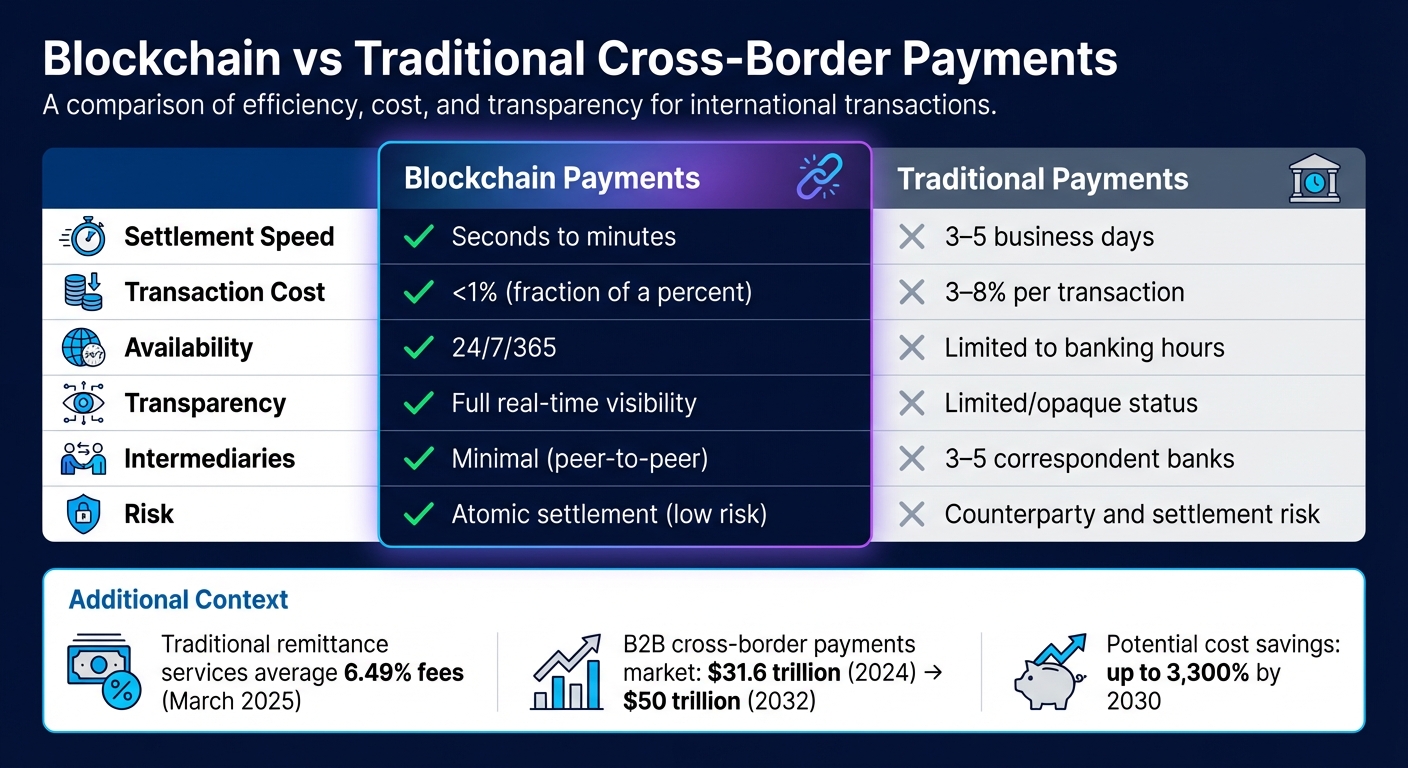
Blockchain vs Traditional Cross-Border Payments Comparison
Building on the streamlined process mentioned earlier, blockchain offers several advantages compared to traditional systems.
Speed: Transactions are processed in seconds or minutes, operating continuously 24/7/365, unaffected by weekends, holidays, or time zone differences.
Lower Costs: Blockchain eliminates the need for 3–5 intermediary banks, which drastically cuts transaction fees. Traditional banks typically charge between 3% and 8% for international transfers, while remittance services average around 6.49% as of March 2025. In contrast, blockchain-based payments usually cost only a fraction of a percent.
Transparency: Blockchain’s shared ledger enables all participants to monitor transactions in real-time. This transparency removes the opaqueness of traditional banking systems and simplifies auditing and compliance processes.
Here’s a quick comparison of blockchain-based payments versus traditional methods:
Blockchain vs. Traditional Payment Systems
| Feature | Blockchain Payments | Traditional Payments |
|---|---|---|
| Settlement Speed | Seconds to minutes | 3–5 business days |
| Transaction Cost | Low (fraction of a percent) | High (3–8% per transaction) |
| Availability | 24/7/365 | Limited to banking hours |
| Transparency | Full real-time visibility | Limited/opaque status |
| Intermediaries | Minimal (peer-to-peer) | 3–5 correspondent banks |
| Risk | Atomic settlement (low risk) | Counterparty and settlement risk |
The B2B cross-border payments market hit $31.6 trillion in 2024 and is expected to grow by 58%, reaching $50 trillion by 2032. Studies suggest that using blockchain for cross-border payments could lead to cost savings of up to 3,300% by 2030. Companies like Deel have already embraced blockchain, offering stablecoin payouts to freelancers in over 100 countries. This ensures fast payments without the delays of traditional banking systems.
Challenges and Regulations
Blockchain’s potential is often hampered by outdated and inconsistent regulatory systems, making international trade more complex. Each country enforces its own rules, creating a patchwork of regulations that businesses must navigate. This fragmented approach not only complicates compliance but also drives up costs.
Common Challenges with Blockchain Payments
One major hurdle is dealing with different regulatory requirements across jurisdictions. For example, handling payments between the United States, Singapore, and Brazil means complying with three distinct legal frameworks. This forces companies to build intricate compliance systems to meet each region’s standards.
Another obstacle is interoperability. Blockchain platforms frequently struggle to communicate with one another due to both technical and regulatory misalignment. Research by the World Bank Group highlights this issue, with their study on blockchain interoperability attracting over 33,540 downloads by early 2021. This level of interest underscores the urgency of solving these challenges. Additionally, non-bank players often face limited access to traditional payment systems, creating further adoption barriers for blockchain solutions.
Together, these operational and technical issues are made even more challenging by strict regulatory demands.
Meeting Regulatory Requirements
Compliance with Anti-Money Laundering (AML) and Know Your Customer (KYC) regulations becomes particularly tricky in a globalized, fragmented regulatory environment. For instance, the FATF Travel Rule requires Virtual Asset Service Providers (VASPs) to share detailed information about transaction originators and beneficiaries for amounts exceeding $1,000 or €1,000. However, this can conflict with data privacy laws like the EU’s GDPR and California’s CCPA, complicating cross-border transactions.
In the United States, businesses may need over 50 Money Transmitter Licenses to operate legally. Meanwhile, the European Union’s MiCA framework requires VASP registration, with capital requirements ranging from $0 to over $5 million. Additionally, firms must retain data for five to seven years, adding to the compliance burden.
"Achieving interoperability will require the public and private sectors to come together in shaping a transparent, efficient and inclusive cross-border payments ecosystem" – World Economic Forum.
To address these challenges, many companies are turning to specialized compliance tools. APIs like Chainalysis (starting at $100,000 per year), Elliptic (priced between $50,000 and $200,000 annually), and TRM Labs help monitor blockchain activity for high-risk patterns in real time. These tools streamline compliance across jurisdictions with API latency under 300ms, offering businesses a way to automate and simplify their regulatory obligations.
Conclusion
Blockchain technology is changing the game for cross-border payments. With the global cross-border payment market valued at around $1 quadrillion and B2B transactions expected to hit $50 trillion by 2032, the potential is enormous. Between 2019 and 2025, stablecoins facilitated an estimated $279.9 trillion in global payment activity. Blockchain’s ability to settle payments in seconds or minutes, paired with negligible fees and 24/7/365 operation, eliminates the need for costly intermediary banks. Freelancers in over 100 countries are increasingly choosing stablecoin payments through platforms like Deel. Meanwhile, companies such as Worldpay and dLocal have embraced blockchain rails to support industries like marketplaces, travel, and gaming.
The impact on the industry is clear:
"By integrating System Pay Services stablecoin capabilities, we can offer even faster, borderless payments – without compromising compliance or control." – John O’Brien, CRO, dLocal
However, challenges persist, including fragmented regulations, gaps in interoperability, and compliance hurdles. For example, regulatory frameworks like the FATF Travel Rule require careful adherence.
Key Takeaways
- Speed and Cost: Blockchain enables near-instant transactions with minimal fees compared to traditional banking systems.
- Stablecoins: These provide the benefits of blockchain technology while avoiding the price volatility of cryptocurrencies.
- Compliance Tools: Solutions like Chainalysis and TRM Labs (costing $50,000–$200,000 annually) help businesses manage regulatory requirements effectively across borders.
To maximize blockchain’s potential, focus on inefficient payment corridors, use platforms with integrated compliance tools, and build strong local banking partnerships to handle fiat conversions seamlessly. Blockchain technology delivers results, but success lies in smart, strategic implementation.
FAQs
Do I need a bank to send stablecoin payments cross-border?
No, banks are not necessary for sending stablecoin payments across borders. Thanks to blockchain technology, stablecoins – digital tokens linked to fiat currencies like the US dollar – can be transferred instantly, at any time, without relying on traditional banking systems. Numerous platforms now facilitate stablecoin transactions, allowing businesses to send, receive, and even convert them into local currencies. This provides a faster and more cost-effective option compared to standard bank transfers.
What happens if I send to the wrong wallet address?
When you send funds to the wrong wallet address, the transaction is generally permanent. Blockchain transactions are designed to be final, meaning they can’t be reversed. This could result in your funds being lost forever or ending up with someone you didn’t intend to send them to. To prevent this, always double-check wallet addresses carefully before making any payments.
How do AML/KYC rules affect blockchain cross-border payments?
AML (Anti-Money Laundering) and KYC (Know Your Customer) regulations play a critical role in shaping blockchain-based cross-border payments. These rules are designed to prevent illegal activities, such as money laundering, by ensuring compliance across financial systems.
Blockchain technology offers transparency by allowing transaction histories to be traced. However, its decentralized framework makes it challenging to enforce consistent KYC procedures across the board. For instance, while the blockchain ledger is open, ensuring every participant adheres to the same rules isn’t always straightforward.
To address this, regulations like the FATF Travel Rule mandate the sharing of customer data between parties involved in transactions. This has led to the development of creative compliance solutions that aim to strike a balance between maintaining transparency and protecting user privacy. At the same time, businesses must navigate the complexities of varying laws across different jurisdictions, making global compliance a tricky but necessary endeavor.