Netflix and YouTube make watching content tailored to your tastes easier by using advanced algorithms that track your habits across devices. Whether you start a show on your phone and finish it on your TV or switch between YouTube videos on your laptop and tablet, both platforms ensure your experience feels uninterrupted and personalized.
Key Takeaways:
- Netflix: Tracks your viewing habits, device usage, and even the time of day to recommend shows and movies. It syncs your progress across devices and uses global data to refine suggestions, saving time and reducing decision fatigue.
- YouTube: Processes 80 billion signals daily to create a personalized feed. It prioritizes "valued watch time" over clicks, syncs your activity across devices via your Google account, and allows you to fine-tune recommendations with tools like "Not interested."
Both platforms excel in delivering content suited to your preferences, but Netflix is ideal for longer sessions and curated options, while YouTube focuses on real-time engagement and variety. Your choice depends on what you’re in the mood for: a binge-worthy series or quick, diverse content.
Quick Comparison:
| Feature | Netflix | YouTube |
|---|---|---|
| Algorithm Focus | Curated recommendations, global data | Real-time engagement, valued watch time |
| Cross-Device Sync | Tracks progress seamlessly across devices | Syncs activity via Google account |
| Content Variety | Licensed movies and shows | User-generated videos |
| User Controls | Limited interaction tools | Options to fine-tune recommendations |
Netflix saves users time by reducing search fatigue, while YouTube’s system encourages discovery and interaction.
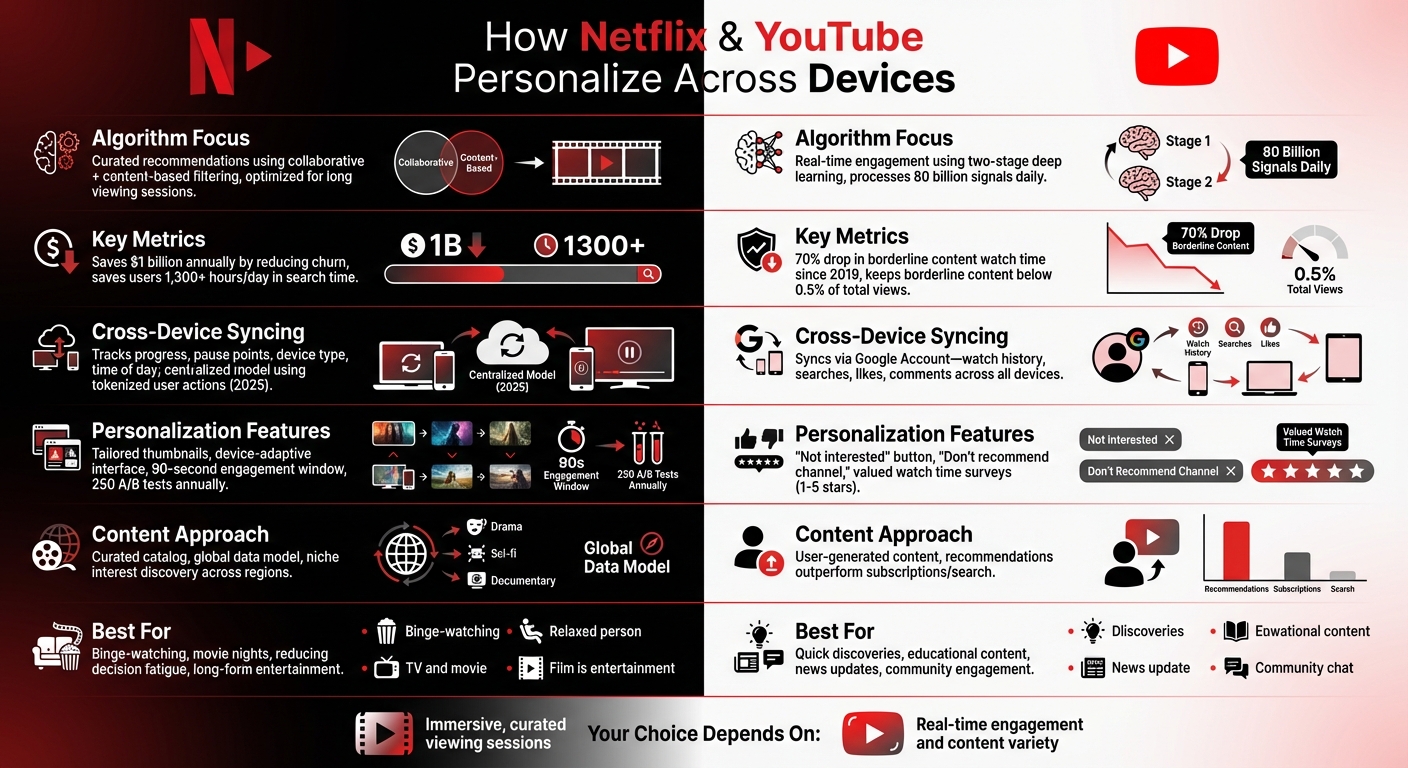
Netflix vs YouTube Personalization: Algorithm Features and Cross-Device Syncing Comparison
1. Netflix
Recommendation Algorithms
Netflix tailors your homepage experience in three key ways: by selecting which rows to display (like "Continue Watching" or "Today’s Top Picks"), choosing the titles within those rows, and determining the order in which those titles appear. It achieves this by analyzing your viewing habits, ratings, and preferences, along with those of users with similar tastes. It also considers metadata like genre, release year, and cast. Context plays a role, too – factors like the device you’re using, the time of day, your language settings, and how long you watched a title all influence the recommendations. To keep things fresh, Netflix occasionally introduces varied content to gauge your interest in new categories. These recommendations are updated daily, and the platform has about 90 seconds to grab your attention before you might decide to leave.
To refine its suggestions further, Netflix uses a global model that identifies shared interests across different regions. For example, a Sci-Fi enthusiast in Argentina can help shape recommendations for someone with similar tastes in India. This global approach ensures that even niche interests benefit from a broader pool of data. As Yves Raimond and Justin Basilico from Netflix’s TechBlog explain:
"Being able to discover worldwide communities of interest means that we can further improve our recommendations, especially for niche interests, as they will be based on more data".
These advanced algorithms also lay the groundwork for Netflix’s seamless experience across devices.
Cross-Device Syncing
Netflix takes its recommendation system a step further by ensuring that your viewing experience is uninterrupted, no matter which device you’re using. Every interaction – whether it’s a click, a pause, or how long you watch – is tracked in real time so your progress syncs flawlessly across devices. The "Continue Watching" feature uses data like where you left off, how much time has passed since your last session, and the device you’re using to predict whether you’ll resume a title.
As of 2025, Netflix has adopted a centralized model inspired by large language technologies. This system consolidates your entire interaction history, tokenizing user actions with metadata (like device type, location, and viewing duration) to enable lightning-fast syncing when you switch devices. The platform even adjusts its interface based on real-time factors like your location and the time of day. For instance, it might prioritize shorter content on mobile devices during late-night hours.
User Experience Enhancements
Beyond its algorithms and syncing capabilities, Netflix continuously fine-tunes its interface to keep viewers engaged. The homepage layout is personalized, with titles ranked and arranged in rows specifically for each user. The platform also adapts to language preferences. For example, it adjusts the horizontal scroll direction for Arabic and Hebrew speakers and optimizes Korean indexing to minimize the number of character inputs needed.
When new users sign up, they can choose a few titles to give Netflix an initial idea of their preferences, although actual viewing behavior quickly takes precedence. Even search results are tailored to reflect your interests and past behavior. Currently, Netflix supports 21 languages and operates in over 190 countries. Its advanced recommendation system not only enhances user satisfaction but also saves the company over $1 billion annually by significantly reducing subscription cancellations.
2. YouTube
Recommendation Algorithms
YouTube’s recommendation system processes an astounding 80 billion signals daily to fine-tune your personalized feed. The platform uses a two-step approach: first, it narrows down billions of videos to a few hundred candidates, then ranks those videos to create a custom feed just for you. This process is applied across various areas of the platform, including your Homepage, the "Up Next" panel, and the Shorts feed.
Instead of just focusing on raw viewing minutes, YouTube prioritizes what it calls "valued watch time." To gauge this, the platform uses 1–5 star rating surveys to determine how meaningful or satisfying a video was for viewers. Cristos Goodrow, YouTube’s VP of Engineering, explains:
"We don’t want viewers regretting the videos they spend time watching and realized we needed to do even more to measure how much value you get from your time on YouTube".
The platform also employs collaborative filtering, which compares your viewing habits with those of other users to suggest videos you haven’t seen yet. Back in 2012, YouTube shifted its focus from clicks to watch time, which led to a 20% drop in views as it moved away from promoting clickbait. Today, this refined recommendation system drives more views than channel subscriptions or search combined. Plus, it ensures a seamless experience across all your devices.
Cross-Device Syncing
By linking your activity to your Google Account, YouTube makes sure your experience is consistent across devices. Whether you’re watching on your phone, laptop, or smart TV, your watch history, search queries, likes, and comments are synced centrally. This means you can pick up right where you left off, no matter the device. The system even takes into account the device you’re using and the time of day to recommend the most relevant content in real time. Ad preferences also stay consistent across platforms. However, for users who are signed out, personalization is limited to the specific browser or device being used, as settings are stored locally via cookies.
User Experience Enhancements
YouTube gives users tools to fine-tune their feed and viewing experience. Features like the "Not interested" and "Don’t recommend channel" buttons let you actively shape the algorithm to better align with your preferences. If you disable your watch history, the Homepage shifts to a simpler layout with just a search bar and an Explore menu, prioritizing privacy over algorithm-driven suggestions.
The platform also works to reduce the spread of low-quality content. It demotes borderline videos and prioritizes trustworthy sources, particularly for news and sensitive topics. After rolling out these changes in 2019, YouTube reported a 70% drop in watch time for borderline, non-subscribed content in the U.S.. The goal is to keep views of borderline content from recommendations below 0.5% of total views.
The Science Behind Netflix Recommendations Virtual Workshop
sbb-itb-6893d99
Pros and Cons
Here’s a closer look at how Netflix and YouTube stack up, highlighting their strengths and drawbacks based on their unique approaches to personalization and content delivery.
Netflix is all about keeping users hooked for longer sessions, relying on a mix of collaborative and content-based filtering to create a seamless, immersive viewing experience. YouTube, on the other hand, focuses on real-time engagement, processing an astonishing 80 billion signals daily through a two-stage deep learning system to generate a personalized feed.
| Feature | Netflix Strengths | Netflix Weaknesses | YouTube Strengths | YouTube Weaknesses |
|---|---|---|---|---|
| Algorithm Approach | Tailored thumbnails and artwork based on viewing history; adapts to device type and time of day | Struggles with licensing restrictions and "cold start" challenges for new users | Uses advanced deep learning for candidate generation and ranking; relies on viewer surveys to measure valued watch time | Clickbait issues have been addressed, but privacy settings like paused history limit personalization |
| Cross-Device Sync | Smooth "Continue Watching" feature across devices; easy resume options | Gaps in data when content isn’t available in certain regions | Syncs watch history, searches, and subscriptions across devices | Full personalization requires users to sign in |
| Content Discovery | Global data helps surface niche interests and reduces search time | Limited to a curated catalog, offering less variety compared to YouTube | Massive library of user-generated content; recommendations often outperform subscriptions or search in driving views | Faces "filter bubble" concerns; actively works to demote borderline content and misinformation |
| User Control | Offers like/dislike options, profile preferences, and runs 250 A/B tests annually | Less interactive, with fewer community engagement tools compared to YouTube | Includes "Not interested" and "Don’t recommend channel" features; users can disable watch history | Disabling watch history significantly reduces recommendation accuracy |
Netflix’s recommendation engine reportedly saves the company over $1 billion annually by minimizing subscriber churn. Meanwhile, YouTube’s focus on valued watch time has led to a 70% drop in views of borderline content since changes implemented in 2019.
Conclusion
When it comes to cross-platform personalization, Netflix and YouTube offer two distinct approaches tailored to different viewing habits. Netflix focuses on delivering a curated and seamless experience, ideal for those looking to settle in for a movie night or binge-watch a series. Its algorithm learns your preferences over time, reducing the need for endless scrolling and helping you dive straight into content you’ll enjoy.
On the other hand, YouTube thrives on real-time engagement. Using a two-stage deep learning system, it surfaces a wide variety of content that aligns with your current interests while encouraging interaction within its community.
Netflix’s hybrid algorithm, combining collaborative and content-based filtering, is particularly effective for long-form entertainment and minimizing decision fatigue. Meanwhile, YouTube shines when it comes to discovering educational videos, news updates, or new creators. Its focus on valued watch time and authoritative content makes it a go-to platform for exploring diverse topics. Interestingly, Netflix has also been credited with saving users over 1,300 hours per day in search time.
In short, Netflix is your best bet for a curated, immersive viewing experience, while YouTube is perfect for quick discoveries and community-driven exploration. Your choice ultimately depends on your viewing preferences and what you’re in the mood for.
FAQs
How do Netflix and YouTube personalize your experience across all your devices?
Netflix and YouTube rely on machine learning models to create a smooth and personalized experience across all your devices. These models dig into details like your viewing history, how long you watch, your language preferences, and even the device you’re using.
By aligning these preferences, they make sure your recommendations feel customized, whether you’re streaming on your phone, tablet, or TV. This seamless cross-device personalization ensures your entertainment feels consistent and effortless, no matter where you decide to watch.
How do Netflix and YouTube personalize recommendations across devices?
Netflix and YouTube rely on sophisticated algorithms to deliver personalized recommendations that align with your tastes and habits. Netflix takes into account a wide range of factors, including what you’ve watched before, the ratings you’ve given, your favorite genres, preferred actors, release years, and even details like the time of day, your chosen language, the device you’re using, and how long you stick with specific shows or movies.
YouTube, on the other hand, hones in on your viewing patterns, likes and dislikes, subscriptions, explicit feedback, and the overall reputation and quality of the channels you engage with.
Both platforms ensure your preferences are synced across all your devices, so you get a smooth, tailored experience no matter where or how you tune in.
How do Netflix and YouTube create a seamless experience across devices?
Netflix and YouTube have mastered the art of creating a seamless experience, no matter what device you’re using. Their advanced algorithms sync your activity to your account in real time, making it a breeze to pick up right where you left off or enjoy personalized recommendations across all your devices.
Netflix takes personalization to another level by considering factors like your viewing habits, the device you’re using, and even the time of day. For instance, if you pause a show on your phone, Netflix saves your spot and updates your recommendations instantly. This means you can switch to your TV or laptop later and dive back in without missing a beat.
YouTube works in a similar way, integrating your likes, subscriptions, and watch history across platforms. Whether you’re on your phone, desktop, or smart TV, your personalized feed and "Continue watching" queue stay perfectly synced. Both platforms rely on powerful AI to process your activity in real time, ensuring a smooth and tailored experience every time you watch.