Generative AI is transforming customer service by reducing response times, improving satisfaction, and boosting efficiency. Companies like Verizon, Lenovo, and UPS are already seeing measurable results, such as a 40% increase in sales, 20% faster handle times, and 50% quicker email resolutions. This technology leverages Large Language Models (LLMs) to provide natural, real-time responses, automate repetitive tasks, and support multilingual interactions.
Key Takeaways:
- Verizon: 40% sales growth with AI tools assisting 28,000 agents.
- Lenovo: 20% reduction in handle time using AI-powered chat services.
- UPS: Email resolution times cut in half with automated systems.
- United Airlines: Customer satisfaction increased 6% through AI-driven notifications.
- Klarna: $40M profit improvement by replacing 700 agents with AI.
Generative AI is helping businesses handle large volumes of queries, improve efficiency, and enhance customer experiences, all while allowing human agents to focus on complex issues.
How to Use Generative AI for Enhanced Customer Experience | Sprinklr
sbb-itb-6893d99
5 Generative AI Customer Service Case Studies
These examples highlight how businesses are leveraging generative AI to improve efficiency and enhance customer interactions. Each case study showcases a unique approach and measurable outcomes.
1. Verizon: Empowering Agents to Drive Sales

In May 2024, Verizon Consumer Group CEO Sampath Sowmyanarayan introduced Google Gemini-powered tools to its 28,000 service agents. The AI assistant, trained on 15,000 internal documents, helped agents find answers more quickly. By January 2025, this initiative led to a 40% boost in sales and a 95% query resolution rate.
"We are doing reskilling in real time from customer care agents to selling agents."
2. ING: Smarter Conversations with AI

ING teamed up with QuantumBlack, McKinsey’s AI division, to pilot a generative AI assistant. The system was designed with safeguards to ensure human intervention for low-confidence responses. The pilot improved issue categorization and sped up escalation to experts, enabling a more seamless support experience.
"Virtual agents have the potential to answer any question and provide a more natural conversational flow."
3. Best Buy: Streamlining Personalized Support

Best Buy implemented Google Cloud‘s Gemini models, Vertex AI, and Contact Center AI to enhance both customer-facing virtual assistants and agent tools. These technologies automate repetitive tasks, allowing agents to focus on resolving more complex issues.
"At Best Buy we look at how gen AI can help enable our overall enterprise strategy while solving real human needs."
4. UK Financial Services Firm: Speeding Up Complaint Resolution
A UK-based financial services firm, with annual revenue of around $5 billion, utilized C3 Generative AI to index over 180 documents. The system was operational in just two days, and within a week, specialists reported a 90%+ reduction in the time needed to access information for resolving customer complaints.
5. United Airlines: Real-Time Transparency
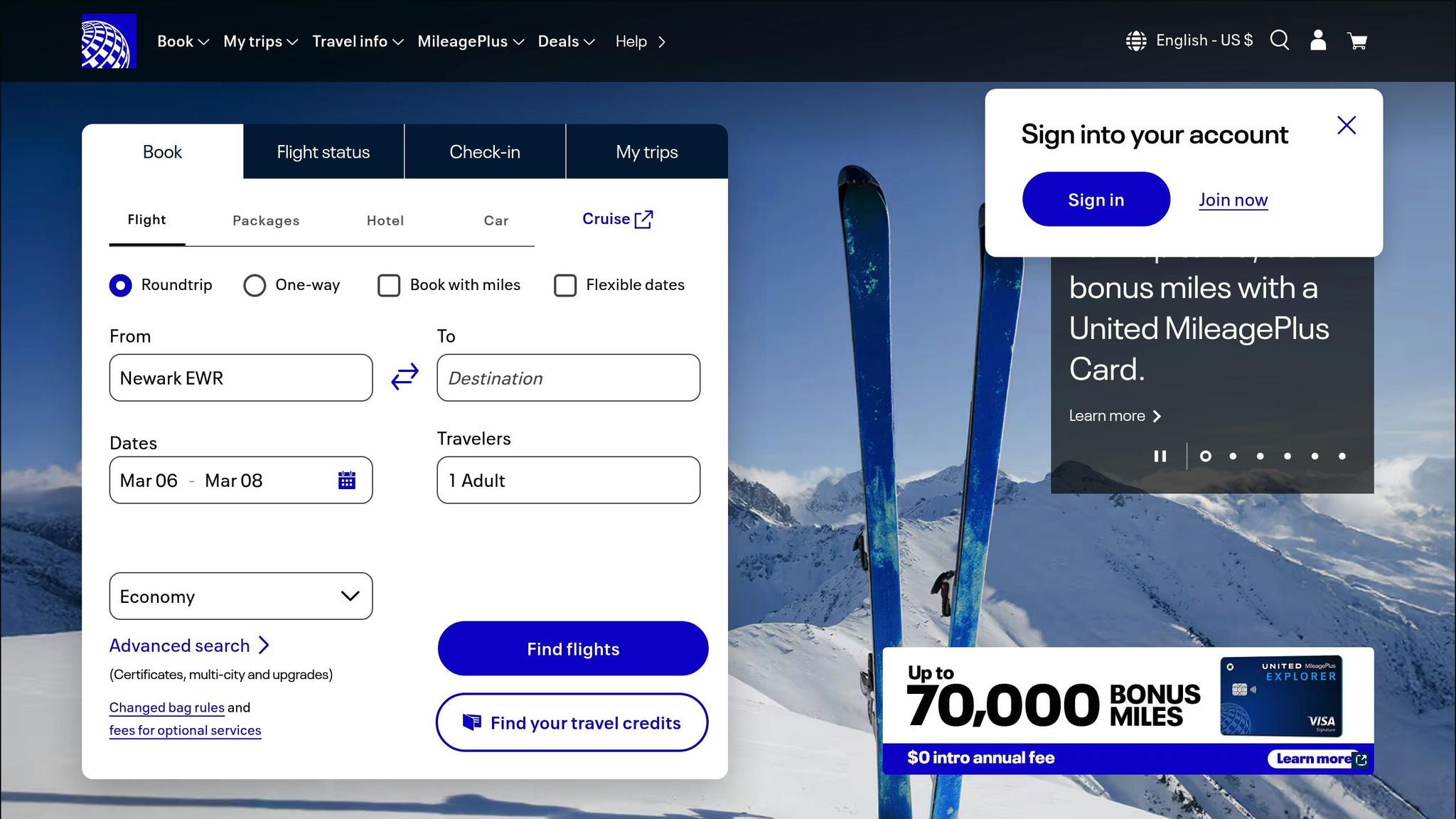
In February 2024, United Airlines’ CIO Jason Birnbaum introduced the "Every Flight Has a Story" initiative. Generative AI was used to craft clear SMS and app notifications explaining flight delays, with human reviewers ensuring the messages aligned with the airline’s tone. This effort increased customer satisfaction by 6%, and plans are in place to expand coverage from 15% to 50% of flights.
Comparison of Case Study Outcomes
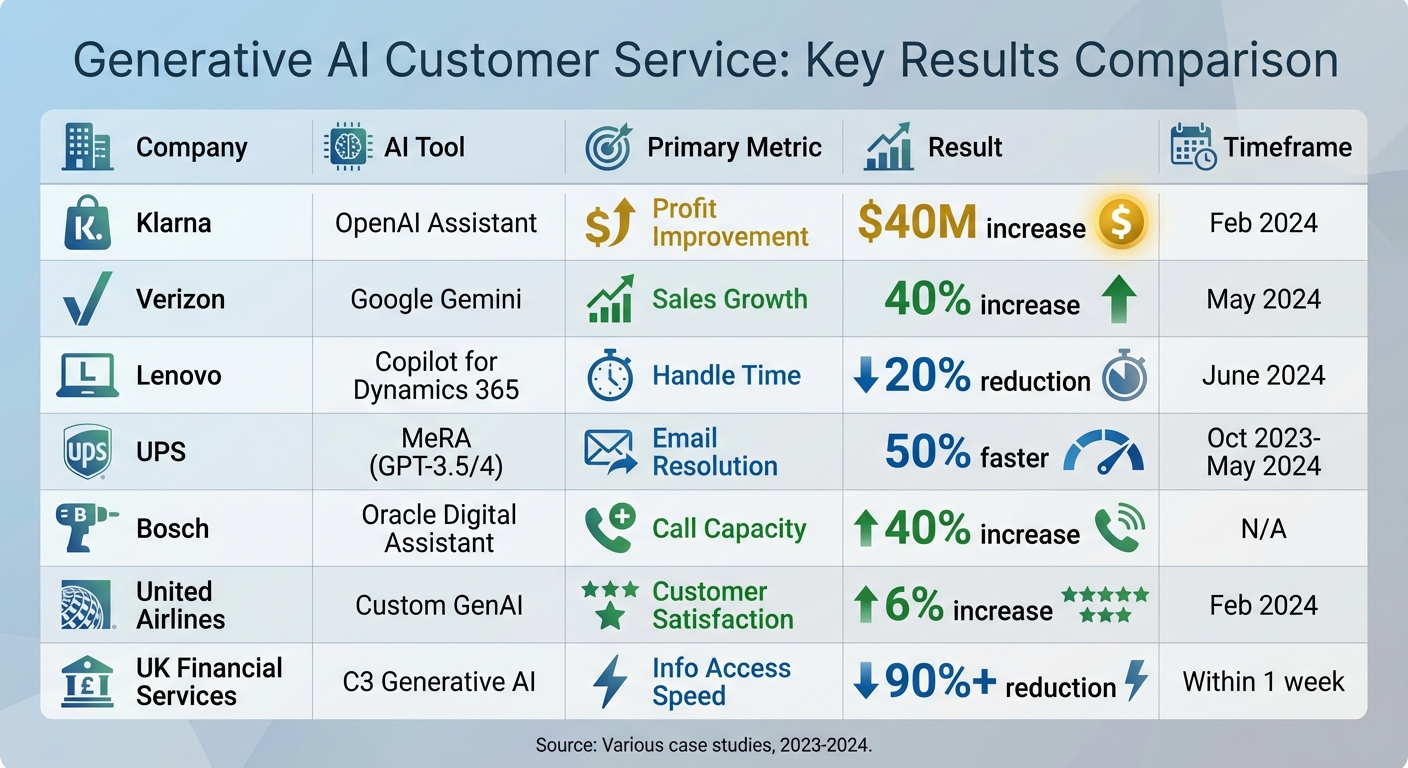
Generative AI Customer Service Results: 7 Companies Compared
Looking at the results of various case studies highlights how different industries prioritize goals like speed, cost efficiency, or revenue growth.
Klarna reported the most impressive financial gains, with a $40 million profit improvement in February 2024. Their OpenAI-powered assistant managed 2.3 million conversations, effectively replacing the workload of 700 full-time agents. This also slashed resolution times from 11 minutes to under 2 minutes.
Verizon took a different route by using Google Gemini to turn customer service agents into sales agents. This shift led to a 40% increase in sales by May 2024, with agents resolving 95% of customer queries comprehensively. On the other hand, UPS concentrated on improving email resolution times. By implementing their MeRA system, they achieved a 50% reduction in the time agents spent handling customer emails during pilot testing.
The telecommunications and logistics industries demonstrated some of the fastest improvements. Lenovo, for instance, reduced average handle time by 20% and boosted productivity by 15% within just a few months of deploying Copilot for Dynamics 365. Similarly, Bosch Service Solutions in Brazil increased their call-handling capacity by 40% using their virtual assistant, "Beto", which autonomously resolved 50% of conversations.
The table below provides a snapshot of these key metrics.
Comparison Table: Key Metrics
| Company | AI Tool/Platform | Primary Metric | Result | Timeframe |
|---|---|---|---|---|
| Klarna | OpenAI Assistant | Profit Improvement | $40M increase | Feb 2024 |
| Verizon | Google Gemini | Sales Growth | 40% increase | May 2024 |
| Lenovo | Copilot for Dynamics 365 | Handle Time | 20% reduction | June 2024 |
| UPS | MeRA (GPT-3.5/4) | Email Resolution | 50% faster | Oct 2023-May 2024 |
| Bosch | Oracle Digital Assistant | Call Capacity | 40% increase | N/A |
| United Airlines | Custom GenAI | Customer Satisfaction | 6% increase | Feb 2024 |
| UK Financial Services | C3 Generative AI | Info Access Speed | 90%+ reduction | Within 1 week |
Common Trends from Case Studies
Looking at individual case studies is insightful, but stepping back reveals broader trends that stretch across industries. These trends highlight how generative AI is reshaping customer interactions and business operations.
Self-Service Revolution
Generative AI is changing how customers handle problems on their own. Instead of clicking through endless menus or hunting down answers on FAQ pages, they can simply type out their questions and get instant, accurate responses. For example, Delta Airlines reported a 20% drop in call center volumes after introducing its "Ask Delta" chatbot. Similarly, H&M slashed response times by 70% compared to using human agents alone.
But it’s not just about answering basic questions. Customers are now managing tasks like changing subscriptions, tracking orders, and troubleshooting – all without needing a human agent. A great example is Bosch Service Solutions in Brazil. Their virtual assistant, "Beto", autonomously resolved 50% of conversations across 10 different topics, handling over 200,000 interactions. This lets human agents focus on cases that require empathy or complex problem-solving.
Predictive Analytics in Customer Support
The shift from reactive to proactive support is another major trend. Companies are using AI to predict and address issues before customers even notice them. By analyzing patterns in behavior, transaction history, and interaction data, AI can flag potential problems like missed payments, service disruptions, or product malfunctions.
This predictive approach saves time by offering instant access to unified data. For instance, a global financial services leader leveraging C3 Generative AI cut information retrieval time by over 90%. ING’s Chief Analytics Officer, Bahadir Yilmaz, highlighted that while introducing generative AI is important, it’s just the beginning. "Ninety-five percent of the job starts after that", he explained. These predictive capabilities allow businesses to deliver faster, more scalable support.
Real-Time Assistance and Scalability
Generative AI also excels at providing instant support while scaling to meet demand without needing to add more staff. For example, Lenovo’s real-time translation feature reduced handle time by 20% and increased productivity by 15%. Meanwhile, ING used AI to serve 20% more customers in just the first seven weeks of its pilot, handling 85,000 queries per week.
AI systems also shine during peak times. TS Imagine automated email monitoring with AI, saving 30% in costs and more than 4,000 hours of manual effort. This ability to scale ensures businesses can maintain high service quality during busy periods like holidays, major product launches, or unexpected demand spikes – all without scrambling to hire extra staff.
Conclusion
Key Takeaways
The 10 case studies paint a clear picture: generative AI isn’t here to replace human agents – it’s here to make them better. Take Verizon, for instance, which saw a 40% increase in sales, or Lenovo, which managed to reduce handle time by 20% and improve productivity by 15% using tools like automated summarization and real-time translation.
The secret to success lies in starting with a strong data foundation, running focused pilot programs, and maintaining strict controls – especially in industries like banking and healthcare, where regulations are tight. Companies that are using AI to deliver personalized and proactive support are seeing the biggest wins. For example, MetLife boosted customer satisfaction by 13% by using sentiment analysis to guide agents in real time. Similarly, Motel Rocks managed to deflect 43% of tickets through intelligent self-service systems. These results suggest that as AI continues to evolve, customer service will become even more tailored and efficient.
Future Outlook for Generative AI
The results we’ve seen so far are just the beginning. Within the next three years, 95% of global customer service leaders anticipate that customers will interact with AI bots at some point during their support journey. These bots won’t just answer questions – they’ll handle tasks like rebooking flights or managing subscriptions entirely on their own.
Experts predict we’re heading toward a "segment of one" model, where AI treats every customer as a truly unique individual, drawing on their complete interaction history and real-time behavior. This evolution from reactive to predictive support will push businesses to adopt hyper-personalized and proactive approaches. Companies that invest in centralized data systems and frameworks for human-AI collaboration will be well-positioned to thrive as these technologies continue to advance.
FAQs
How does generative AI make customer service more efficient?
Generative AI is transforming customer service by simplifying and automating essential tasks. It offers real-time, context-specific suggestions to agents, helping them respond more quickly and accurately. On top of that, it bridges language barriers by supporting multilingual communication, making it easier to assist a diverse range of customers.
The results are impressive – contact center productivity can increase by 15% to 50%, all while cutting down on handling times. By taking over repetitive tasks and enhancing the quality of responses, generative AI frees up teams to tackle more complex problems and deliver a superior customer experience.
What benefits have companies experienced by using generative AI in customer service?
Companies using generative AI in customer service are seeing impressive results. Some report profit gains of up to $40 million, along with productivity improvements ranging from 15% to 50%. Beyond that, sales performance has climbed, and tasks once requiring hundreds of customer service representatives are now automated.
By simplifying workflows and boosting efficiency, generative AI not only saves time and cuts costs but also elevates the overall customer experience. This shift allows teams to dedicate more energy to strategic, high-value initiatives.
What steps can businesses take to successfully implement generative AI in customer service?
To make the most of generative AI in customer service, businesses should first pinpoint key areas where AI can make an impact. This could mean enhancing the accuracy of chat responses or offering real-time support to agents. Starting with pre-built, reliable solutions can help achieve quick wins, setting the stage for more advanced features like tailored recommendations or self-service options. Keeping a human-in-the-loop approach is crucial, especially for handling complex or sensitive situations, ensuring AI outputs are reviewed and supported by human agents when needed.
A successful implementation also requires clean, high-quality data, seamless integration with tools like CRM systems, and ongoing checks to catch errors or biases. Set clear objectives – whether it’s boosting customer satisfaction or cutting response times – and test the AI in small, controlled pilot programs before rolling it out on a larger scale. With thoughtful planning, human oversight, and strong data management, businesses can offer faster, more personalized customer support while maintaining trust and reliability.