- IoT sensors: Provide real-time data on energy usage, grid performance, and environmental factors, enabling efficient energy distribution and fault detection.
- Blockchain: Secures this data with tamper-proof ledgers and automates processes through smart contracts, such as energy trading and dynamic pricing.
Key Benefits:
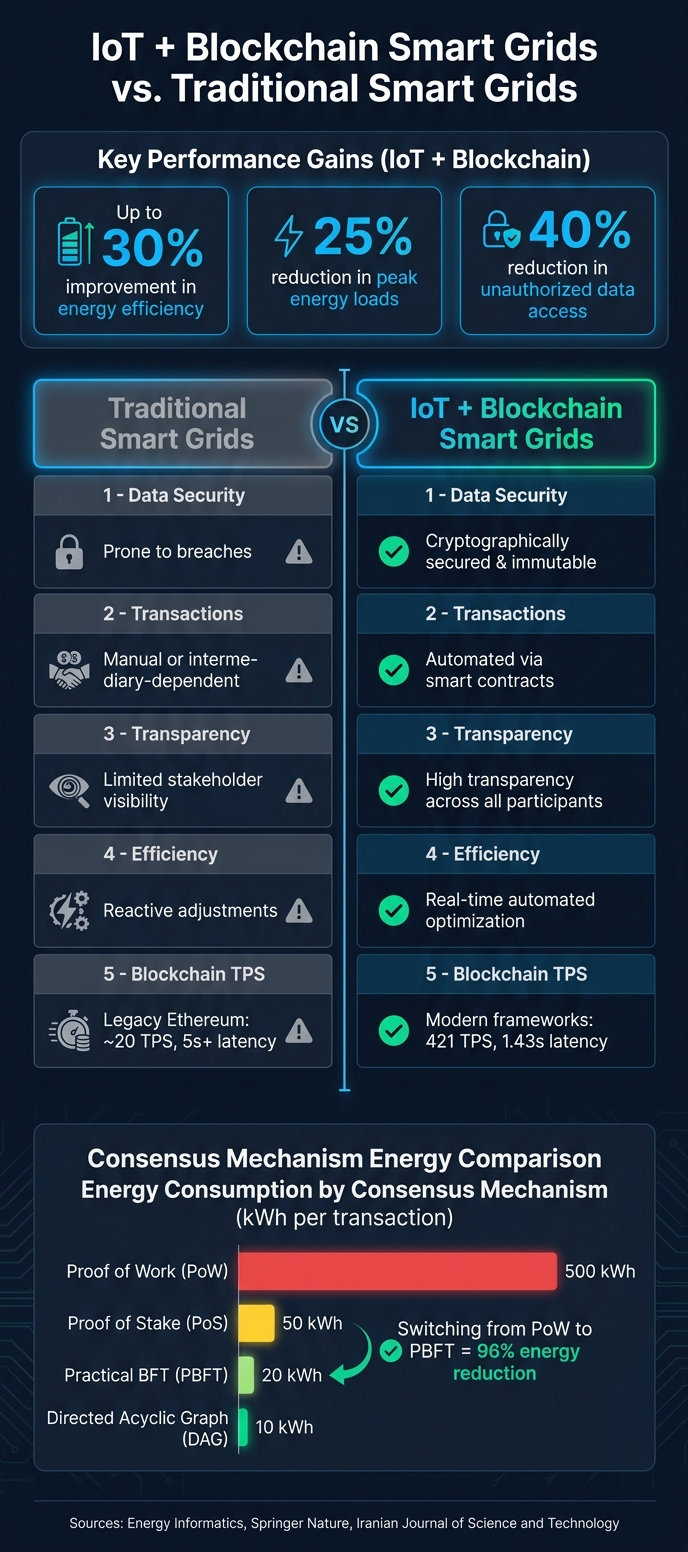
- Energy efficiency: Systems using IoT and blockchain can improve efficiency by up to 30%.
- Peak load reduction: Automated adjustments lower peak energy usage by 25%.
- Data security: Blockchain reduces data breaches by 40%.
Together, these technologies create a reliable, decentralized energy system that supports renewable sources, peer-to-peer trading, and real-time optimizations. However, challenges like scalability, device security, and regulatory compliance must be addressed for widespread adoption.
IoT + Blockchain Smart Grids vs Traditional Smart Grids: Key Metrics & Benefits
Energy Management IoT: Smart Grids & Meters Explained | Beginner’s Guide to IoT Energy Systems
sbb-itb-6893d99
How IoT Sensors Work in Smart Grids
Smart grids rely heavily on a vast network of sensors to ensure electricity flows efficiently and reliably. These sensors constantly monitor variables like voltage, current, and weather conditions, feeding this data into systems that can adjust electricity supply, detect faults, and minimize waste. This section dives into the types of sensors used in smart grids and the challenges faced when deploying them.
Types of IoT Sensors Used in Smart Grids
Different sensors serve specific roles within a smart grid. Smart meters have replaced older electromechanical devices, measuring voltage, current, active and reactive power, frequency, and power factor at the customer level. This data helps grid operators automate billing, analyze load profiles, and manage demand more effectively.
In addition to meters, grid infrastructure sensors are installed in equipment like circuit breakers, distribution lines, switches, and transformers. These sensors monitor the health of grid assets and track grid topology in real time, allowing for quicker fault detection. Weather sensors play a crucial role in renewable energy systems, providing data on solar irradiance, wind speed, humidity, and atmospheric pressure to forecast energy production. Lastly, intelligent terminals measure the frequency of electrical signals at the customer level, aiding in the maintenance of grid power balance.
| Sensor Type | Data Collected | Primary Use |
|---|---|---|
| Smart Meters | Voltage, current, power, frequency, power factor | Billing, load profiling, demand management |
| Grid Infrastructure Sensors | Breaker status, line temperature, switch positions | Fault detection, asset health monitoring |
| Weather Sensors | Solar irradiance, wind speed, humidity, pressure | Renewable energy forecasting |
| Intelligent Terminals | Signal frequency, energy flow timing | Grid frequency balancing |
Take the example of the Gujranwala Electric Power Company (GEPCO). They implemented a four-layer IoT system for industrial loads, tracking real-time power factor data to identify sites operating below the 0.7 threshold, which often incurs cost penalties. After installing capacitor banks at one industrial location, the power factor improved significantly, jumping from 67.5% ± 11.2 to 93.6% ± 2.4.
Challenges in Deploying IoT Sensors
While the variety of sensors enhances the functionality of smart grids, deploying them at scale isn’t without hurdles. With millions of IoT nodes generating massive amounts of data, central processing can lead to delays, undermining the goal of real-time response. To address this, utilities are increasingly adopting edge computing, where data is processed closer to its source, reducing latency and easing network congestion.
Security is another major issue. Many smart meters and phasor measurement units (PMUs) are limited in processing power and memory, making traditional encryption methods impractical. These devices are vulnerable to attacks like Byzantine and Sybil exploits, which can compromise data integrity. Legacy communication protocols like DNP3, Modbus, and Zigbee, still widely used, were not designed to handle modern cybersecurity threats, leaving systems open to unauthorized access. Incorporating Trusted Platform Module (TPM) chips in sensor hardware is one way to securely store cryptographic keys and mitigate tampering risks.
"The critical risk analysis results obtained from fused data become a protected and sensitive product as it pertains to those specific details of any given system under study." – Energy Informatics
Interoperability remains a persistent challenge when trying to integrate modern sensors with older infrastructure. Compatibility issues between ARM and x86 processor architectures often lead to delays and increased costs. Additionally, U.S. utilities must comply with standards like NERC CIP-011, which mandates the protection and anonymization of sensitive cyber-physical data, such as grid topology, before sharing it across different grid operators.
The Role of Blockchain in Smart Grid Operations
IoT sensors gather real-time data, while blockchain ensures that this data is secure and efficiently processed. Think of blockchain as a shared, tamper-proof ledger that everyone on the network can access, but no single entity controls. Together, these technologies create a robust system for monitoring energy usage in real time and securely sharing data within smart grids.
Here’s how blockchain brings value to smart grid operations.
Core Blockchain Features for Smart Grids
Blockchain stands out in smart grids because of three key features. First, its distributed ledger stores every transaction across all network nodes, removing any single points of failure. Second, smart contracts automate actions, such as payments or load adjustments, based on pre-set conditions. Third, cryptographic integrity ensures that each block is linked to the previous one through a unique hash. Any attempt to modify past data disrupts the chain, flagging the tampering immediately.
Merkle Trees add another layer of security by structuring data so that any small change alters the root hash, triggering instant alerts. For consensus, smart grids often rely on Proof of Authority (PoA) or Proof of Stake (PoS), which are more efficient and faster than the energy-intensive Proof of Work used in public cryptocurrencies. These methods are better suited for the speed and efficiency demands of real-time grid operations.
"Blockchain smart contracts ensure decentralized energy exchange free from any possible manipulation." – B. Srinivasarao et al., Iranian Journal of Science and Technology
Benefits of Blockchain for Energy Data Management
Modern blockchain frameworks have come a long way in performance. They can now handle up to 421 transactions per second (TPS) with a latency of just 1.43 seconds, compared to older Ethereum-based systems that maxed out at 20 TPS with over 5 seconds of latency. New decentralized systems further enhance performance, reading data in an average of 25 milliseconds and generating new blocks in about 4 seconds.
Security is another area where blockchain shines. Current systems achieve 96.7% intrusion detection accuracy, with false positives reduced to just 2.1%. On the efficiency front, blockchain terminals consume only 70% of the energy required by traditional data management methods. Optimized encryption models have also cut energy overhead at edge nodes from 23.1% to 18.6%.
These advancements lay the groundwork for practical blockchain applications in the US energy sector.
Blockchain in US Energy: Current Examples
Some exciting real-world applications are already making waves. For instance, a hybrid model combining EnPlus for load forecasting and bid-matching with a private Ethereum blockchain for record-keeping reduced residential energy costs by over 17%. This was achieved by improving the balance between energy supply and demand in prosumer communities.
The Energy Attestation Service (EAS) is another example. It uses a trustless on-chain ledger where IoT devices submit energy readings that are permanently recorded and verifiable. To avoid floating-point errors during smart contract execution, energy data is stored as uint256 values in watt-hours (Wh). If errors occur, a built-in correction mechanism allows for updated attestations while preserving the audit trail.
On the tokenization front, the XRP Ledger (XRPL) converts kilowatt-hours into tradeable digital tokens. As of March 2026, XRPL represents $1.5 billion in asset value and has distributed over $404 million in tokens. Argentine energy company YPF Luz partnered with blockchain firm Justoken to use XRPL, citing its reliability in regulated energy markets as a key factor.
"XRPL was selected for several strategic reasons. First, its institutional quality stands out. Many companies in the energy ecosystem are publicly listed, which aligns with the profile of counterparties involved in this type of business." – Ariel Scaliter, CTO, Justoken
When choosing a blockchain platform, the decision often depends on the specific use case:
| Platform | Access Model | Speed | Cost | Best Fit |
|---|---|---|---|---|
| Ethereum (Public) | Open/Decentralized | Higher latency | High | Public transparency |
| Hyperledger (Private) | Permissioned | High throughput | Low | Corporate/private grids |
| Polygon (Sidechain) | Decentralized/Scalable | High speed, low latency | Low | P2P energy markets |
For peer-to-peer energy trading, frameworks like Polygon or Hyperledger are practical options. They avoid the high fees and delays of public blockchains while still offering the security and transparency needed by grid operators.
How IoT Sensors and Blockchain Work Together
IoT sensors and blockchain combine to securely transfer real-world energy data onto an unchangeable ledger. This partnership creates a system that is far more effective than either technology could achieve on its own.
Data Flow: From IoT Sensors to the Blockchain
IoT sensors gather real-time data – such as electricity usage, temperature, or humidity – and transmit it using lightweight protocols like MQTT or CoAP. This data is then routed to hubs, where it undergoes encryption and validation using consensus methods like Proof of Stake (PoS) or Practical Byzantine Fault Tolerance (PBFT). Once validated, smart contracts execute automated actions, such as energy trades or adjustments, seamlessly. These protocols are designed to work efficiently with resource-constrained devices, ensuring reliability without adding unnecessary overhead. This secure transfer process highlights blockchain’s ability to validate and protect sensor data.
The energy efficiency of different consensus methods varies greatly:
| Consensus Mechanism | Energy per Transaction | Best Fit for Smart Grids |
|---|---|---|
| Proof of Work (PoW) | 500 kWh | Low |
| Proof of Stake (PoS) | 50 kWh | Moderate |
| Practical BFT (PBFT) | 20 kWh | High |
| Directed Acyclic Graph (DAG) | 10 kWh | Very High |
For urban grids managing thousands of connected devices, DAG and PBFT are becoming the go-to choices due to their lower energy requirements.
How Blockchain Builds Trust in IoT Data
This secure data flow is critical for ensuring grid reliability. Blockchain links each data entry cryptographically, making tampering nearly impossible. Its decentralized structure eliminates single points of failure, a common issue in centralized systems. By incorporating blockchain into energy management, incidents of unauthorized data access drop by 40%.
"Using cryptographic methods to ensure data integrity and immutability, the blockchain provides a trusted platform for storing and sharing energy data among stakeholders." – Springer Nature
To further protect privacy, homomorphic encryption enables computations to be performed on encrypted data without revealing the raw information. This allows utility providers to optimize energy distribution without accessing individual household consumption details, a crucial factor in maintaining consumer trust.
Real-Time Monitoring Use Cases
The integration of IoT and blockchain unlocks real-time grid optimizations. One prominent application is automated demand response, where IoT sensors detect load spikes and trigger smart contracts to adjust non-critical loads or reroute energy supply instantly. This approach has been shown to cut peak energy loads by 25%.
Another impactful use case is decentralized energy trading. Across Europe and Asia, pilot projects leveraging IoT-blockchain systems have achieved 30–50% improvements in trading efficiency compared to traditional centralized models. For example, when a household with solar panels generates surplus power, IoT meters log the excess energy, the blockchain verifies the data, and a smart contract facilitates the sale to a nearby buyer. This process happens almost instantly, with no need for intermediaries.
Challenges and What Comes Next
Technical Challenges
Handling the massive data generated by thousands of IoT sensors is no small feat. Centralized systems often struggle with performance once the number of nodes exceeds 500, causing significant scalability issues. On top of that, limited battery life and processing power make it hard for these sensors to handle heavy cryptographic tasks. Another roadblock? The lack of standardized protocols, which complicates communication between devices.
And while these technical issues are daunting, shifting US regulations add another layer of complexity to the mix.
US Regulations and Market Factors
The regulatory environment in the US is in a state of flux. Around 75% of US states have either adopted or referenced IEEE 1547-2018, which recognizes IEEE 2030.5 as an approved communication protocol for distributed energy resources (DERs). A key example of this is California’s Rule 21, which mandates that all grid-connected DERs must support the IEEE 2030.5 protocol.
Cybersecurity is also becoming a focal point. FERC Order No. 918 (Reliability Standard CIP-003-11), effective May 26, 2026, introduces stricter security measures for low-impact Bulk Electric System (BES) cyber systems. As the Federal Energy Regulatory Commission (FERC) explains:
"Proposed Reliability Standard CIP-003-11… improves the reliability of the bulk electric system (BES) by strengthening the cyber security protections for low impact BES Cyber Systems to reduce the risk of compromise." – Federal Energy Regulatory Commission
For hardware manufacturers and grid operators, the stakes are high. Devices might pass interoperability tests but still fail in real-world conditions due to incomplete security checks. Implementing protocols with minimal effort can lead to technical debt, which may require costly redesigns to meet future mandates.
Emerging Trends in Smart Grid Technology
Smart grid technology is evolving rapidly, driven by several emerging trends:
- AI Integration: Artificial intelligence is now being used to detect operational anomalies and forecast demand with impressive accuracy.
- Proof of Authority Consensus: This method reduces latency to under 200 milliseconds and lowers energy consumption to just 0.5–0.9 joules per transaction in private microgrids.
- Privacy-Preserving Techniques: Technologies like zero-knowledge proofs and homomorphic encryption allow for consumption analysis without exposing personal data.
These advancements are setting the stage for a grid infrastructure that’s not only smarter and more efficient but also more privacy-conscious. The future of smart grids looks increasingly geared toward balancing innovation with security and user trust.
Key Takeaways: IoT and Blockchain in Smart Grids
The combination of IoT sensors and blockchain technology is reshaping smart grids by offering better visibility and fostering trust among stakeholders.
IoT sensors collect detailed, real-time energy data, while blockchain ensures this information is stored securely, cannot be altered, and remains accessible without relying on a central authority. Together, these technologies create a system that is both efficient and secure.
Here are some of the measurable benefits:
- Improved energy efficiency: Integrated systems can boost efficiency by up to 30%.
- Reduced peak loads: Automated smart contracts help lower peak energy loads by 25%.
- Enhanced security: Unauthorized data access can be cut by 40%.
Switching from energy-heavy Proof of Work (which uses 500 kWh per transaction) to more efficient models like Proof of Stake or Practical Byzantine Fault Tolerance (50 kWh per transaction) achieves an 80% drop in energy consumption. This shift supports both sustainability goals and operational efficiency.
The table below highlights the differences between traditional smart grids and those enhanced by IoT and blockchain:
| Capability | Traditional Smart Grids | IoT + Blockchain Smart Grids |
|---|---|---|
| Data Security | Prone to breaches | Cryptographically secured, immutable |
| Transactions | Manual or rely on intermediaries | Automated through smart contracts |
| Transparency | Limited visibility for stakeholders | High transparency across participants |
| Efficiency | Reactive adjustments | Real-time, automated optimization |
For the U.S. energy system, these technologies offer a clear path to decentralization and resilience, addressing vulnerabilities like single points of failure that can lead to widespread outages. The Brooklyn Microgrid project has already shown how blockchain-enabled peer-to-peer energy trading works in practice, providing a glimpse into what’s possible. As advancements in AI analytics, privacy-focused encryption, and lightweight protocols (like MQTT) become more common, these systems will only grow stronger and more secure.
This progress points toward a future where the U.S. energy system becomes more decentralized, resilient, and efficient, laying the groundwork for continued advancements.
FAQs
How is sensor data verified before being added to the blockchain?
Sensor data is checked for accuracy and trustworthiness through cryptographic tools like digital certificates, signatures, and consensus mechanisms. These tools safeguard the data by confirming its source and ensuring it hasn’t been altered. Additionally, validation methods compare the incoming data to established models, helping to spot any errors or signs of tampering. Together, these steps create a secure and dependable system for managing data on the blockchain.
Which blockchain consensus method works best for real-time smart grid data?
Proof of Authority (PoA) works well for handling real-time smart grid data because of its low latency (under 200 ms), high transaction throughput (approximately 190 transactions per second), and energy efficiency (0.5–0.9 joules per transaction). These qualities make it a great fit for the resource-limited IoT nodes often found in smart grids.
How can smart grids use blockchain without exposing my household energy usage?
Smart grids leverage blockchain technology to securely log energy transactions while safeguarding household consumption data. The decentralized and cryptographic nature of blockchain ensures both data accuracy and privacy. With tools like smart contracts and privacy-focused techniques, these systems enable secure peer-to-peer energy trading and demand-response mechanisms. This approach ensures efficient energy management while keeping individual energy usage private.